WiFi 6 or WiFi 7 for Your Outdoor Event? Why the Label Matters Less Than You Think
You see it more and more often in quotes: “WiFi 7!”, as if that number alone guarantees your visitors can stream, pay, and post smoothly outdoors. For an open-air event, there is just one catch. And that catch is called the law. WiFi 7 is indeed faster than WiFi 6, but almost all that extra speed comes from one new frequency band — 6 GHz — and that is precisely the band you can barely use outdoors in Belgium. We explain how this works below.
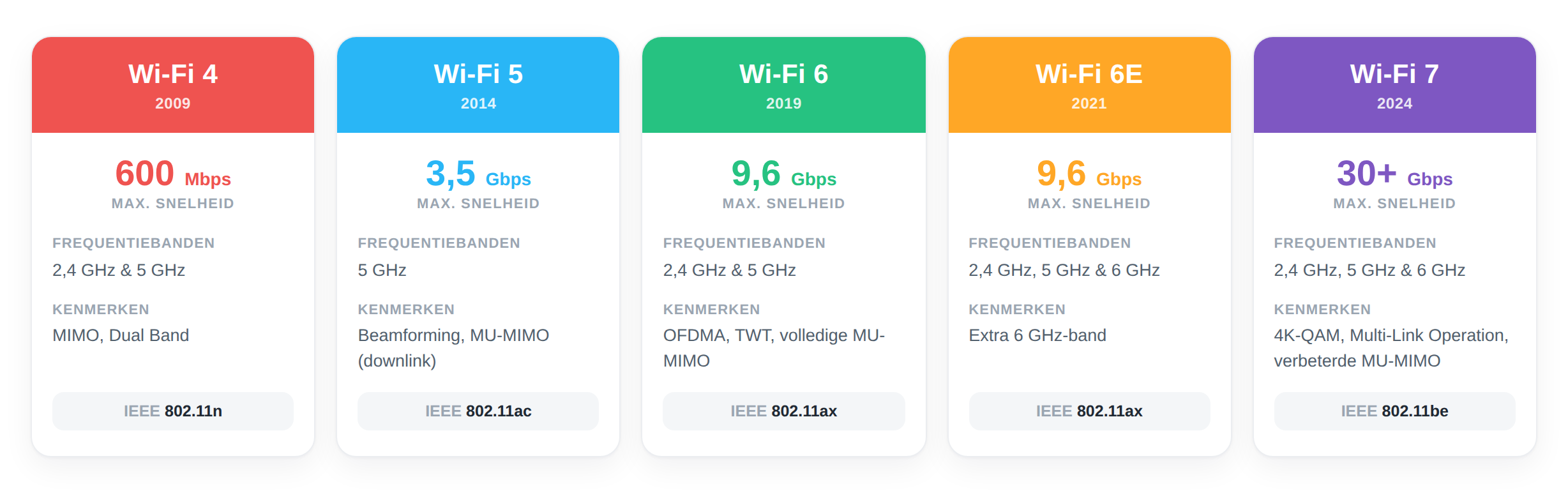
The difference between WiFi 6 and WiFi 7
WiFi works with frequency bands. Think of them as lanes for data. WiFi 6 runs on two lanes: 2.4 GHz (long range, somewhat slower) and 5 GHz (faster, shorter range). WiFi 6E is exactly the same technology with one extra lane: the new 6 GHz band. WiFi 7 uses all three lanes and adds a few clever tricks.
Those tricks are what make WiFi 7 faster. But almost all of them rely on the 6 GHz band. The biggest speed gain comes from doubly wide channels — 320 MHz channels — which only exist on 6 GHz. There is simply no room for them on 2.4 or 5 GHz. In addition, a device with Multi-Link Operation can transmit on multiple bands simultaneously, but the full benefit requires a clean, wide 6 GHz link to switch to. And finally, 4096-QAM packs data more densely — good for around 20% extra speed — but only very close to the device (about one metre) and with an exceptionally strong signal. On an open outdoor site, you will never achieve that.
Remove 6 GHz, and a WiFi 7 device behaves largely like a WiFi 6 device.
Then the law comes in
The European Union, and therefore also Belgium, split the 6 GHz band into two categories with Implementing Decision (EU) 2021/1067. Indoor devices (LPI) may transmit up to 200 milliwatts, but only indoors. Outdoor use is not permitted. Portable devices (VLP) may be used both indoors and outdoors, but at a maximum of 25 milliwatts. That is extremely low, intended for short-range communication between small devices.
A category for powerful outdoor 6 GHz WiFi does not exist in Europe. The United States has something similar via a system called “AFC”, but Europe deliberately chose not to adopt it. The Belgian BIPT is crystal clear: for outdoor WiFi coverage, only the 2.4 GHz and 5 GHz bands are permitted. All other bands, including 6 GHz, are for indoor installations.
WiFi 7’s biggest speed gain lives on a band you cannot meaningfully use outdoors in Belgium.
And that low power level is no minor detail. A standard outdoor access point on 5 GHz may transmit up to 1 watt in Belgium. That portable 6 GHz device is limited to just 25 milliwatts. On top of that, a 6 GHz signal also naturally fades faster. Where a powerful 5 GHz AP can cover tens to well over a hundred metres outdoors, such a device won’t reach much further than a handful of metres.
That is why professional event WiFi relies on 5 GHz for capacity and 2.4 GHz for range — exactly the bands that WiFi 6 and WiFi 7 use identically. The difference between a network that holds up and one that collapses at the busiest moment therefore lies not in the generation label, but in the design: enough access points in the right places, directional antennas, smart channel management, and a solid backhaul to the internet (for example via Starlink or a wired connection).
Precisely because you are working outdoors with limited transmit power, it is better to spread multiple access points across the site, right where coverage is actually needed. Broadcasting everything from a single central point can work in principle, but coverage is rarely optimal that way: the further from the source, the weaker and slower the signal. By placing access points closer to visitors, every zone stays within short range of a strong signal.
Where WiFi 7 genuinely pays off
To be clear: WiFi 7 and 6E are not nonsense. The real point of WiFi 7 simply isn’t peak speed. Those figures on the box almost nobody achieves in practice. The gain lies in reliability and better support for many simultaneous users, without the connection stuttering. Multi-Link Operation lets a device combine multiple bands or switch seamlessly on interference, and the extra room on 6 GHz absorbs congestion without older devices interfering.
The issue is that both of those advantages also rely largely on the 6 GHz band. The density gain comes mainly from that extra clean space, and MLO works best when there is a wide, quiet 6 GHz link to fall back on. Indoors — in buildings, backstage areas, press zones, or fixed VIP locations — you can use 6 GHz, and there reliability and density make a real difference. But outdoors, on your open terrain, you fall back on 2.4 and 5 GHz: the same bands WiFi 6 already has.
What about WiFi 5?
This is almost funny. WiFi 5 works exclusively on 5 GHz, precisely the band that is the workhorse outdoors. A well-designed WiFi 5 network therefore delivers on-site performance close to an expensive “WiFi 7” label, simply because both run on the same band at the same power level.
That does not mean everything is equal. WiFi 6 genuinely adds value outdoors over WiFi 5 — not because of 6 GHz, but because of techniques such as OFDMA that serve many devices simultaneously far more efficiently on that same 5 GHz band. For a busy event, WiFi 6 is therefore a sensible baseline. The jump from WiFi 6 to WiFi 7 adds almost nothing outdoors, whereas the jump from WiFi 5 to WiFi 6 does. The lesson: don’t chase the highest number — look at what you can actually deploy on the ground.
If a supplier pitches “WiFi 7” for outdoor use, ask one question: on which band and at what power does this actually run outdoors? The honest answer is 5 GHz and 2.4 GHz, just like WiFi 6. At AstroRent, we therefore choose not on the basis of the latest number, but on the basis of what your site genuinely needs. That is what makes the difference between visitors who get online smoothly and a network that gives up the moment everyone pulls out their phone at the same time.
Frequently asked questions
Is WiFi 7 better than WiFi 6 for an outdoor event?
Not substantially outdoors in Belgium. WiFi 7’s biggest speed gain comes from the 6 GHz band, which you may only use outdoors at 25 milliwatts — too weak for site-wide coverage. Outdoors, both run on 2.4 and 5 GHz, with equal performance.
Can you use the 6 GHz band outdoors in Belgium?
Only at very low power (max. 25 milliwatts, the VLP category), which is in practice unusable for an event site. Powerful 6 GHz WiFi is legally restricted to indoors. For outdoor coverage, the BIPT only permits 2.4 GHz and 5 GHz.
Does “WiFi 7” on the box always guarantee 6 GHz?
No. There are also WiFi 7 devices that only support 2.4 and 5 GHz. Always check the actual frequency bands — and for outdoor use, the permitted transmit power — rather than going solely by the label.
Is WiFi 5 still usable for an outdoor event?
Yes. WiFi 5 runs on 5 GHz, the band that is the workhorse outdoors, and with good design its performance comes close to WiFi 7. WiFi 6 does add genuine value outdoors over WiFi 5 (more efficient handling of many devices via OFDMA), but the step to WiFi 7 adds almost nothing extra outdoors.
Questions about WiFi or network infrastructure for your event? Astro Rent provides temporary network solutions for events in Belgium, from Starlink connections to managed event WiFi. Get in touch.